For people wondering how is corporate tax calculated in the UAE, the most important thing to understand, before anything else, is that Corporate Tax is not simply 9% of a company’s total revenue or turnover. It’s calculated on taxable income, which is worked out through a series of steps starting from accounting profit:
Accounting Income → Tax Adjustments → Taxable Income → Tax Loss Relief, where applicable → Corporate Tax Rate → Tax Credits → Corporate Tax Payable
Quick Answer
| Item | UAE Corporate Tax rule |
| Corporate Tax introduced | Tax Periods beginning on or after 1 June 2023 |
| 0% rate | Taxable income up to AED 375,000 |
| 9% rate | Taxable income exceeding AED 375,000 |
| Standard taxable-income threshold | AED 375,000 |
| Tax return deadline | Within 9 months after the end of the Tax Period |
| Tax loss offset limit | Generally up to 75% of taxable income before tax-loss relief |
| Small Business Relief revenue threshold | AED 3 million, subject to conditions |
| UAE DMTT | Effective for financial years starting on or after 1 January 2025, for in-scope MNEs |
Step 1: Start With Accounting Net Profit
Accounting net profit is the starting point for calculating UAE Taxable Income, but it is not necessarily the final amount on which Corporate Tax is charged.
Accounting income is the profit or loss shown in a business’s financial statements, prepared under IFRS or, for smaller entities, IFRS for SMEs. Depending on how a business operates, this figure is generally built on an accrual basis, recognising income and expenses when they’re earned or incurred rather than when cash actually changes hands.
The FTA confirms that Taxable Income is based on accounting net profit or loss after required adjustments. In other words, well-prepared financial statements are the foundation the entire Corporate Tax calculation sits on, so accuracy at this stage matters more than it might seem.
Step 2: Make the Required Tax Adjustments
Accounting income and taxable income aren’t the same thing. Businesses need to adjust their accounting profit for items that are treated differently under the UAE Corporate Tax Law before arriving at the taxable figure.
| Tax adjustment | Treatment |
| Exempt income | Deduct/exclude where applicable |
| Non-deductible expenditure | Add back |
| Qualifying dividends | May be exempt subject to conditions |
| Participation income | May qualify for exemption |
| Related-party transactions | Adjust where not at arm’s length |
| Disallowed interest | May require adjustment |
| Entertainment expenditure | Subject to specific deduction rules |
| Unrealised gains/losses | Treatment depends on applicable election/rules |
| Tax losses | May reduce taxable income subject to conditions |
| Qualifying reliefs | Apply where eligibility requirements are met |
Each of these adjustments depends on the specific facts of a business, so this table is a starting point for identifying what might apply, not a substitute for a proper review of your accounts.
Step 3: Apply Tax Loss Relief
A business may carry forward eligible tax losses and use them against future taxable income, subject to the conditions set out in the Corporate Tax Law. The amount used to offset taxable income in any one period is generally capped at 75% of taxable income before tax loss relief, meaning a business can’t reduce its taxable income to zero using losses alone in a single period. Specific conditions also apply to the transfer of losses between companies, particularly within a group structure.
Worked example
| Calculation | AED |
| Taxable income before loss relief | 5,000,000 |
| Maximum loss offset (75%) | 3,750,000 |
| Final taxable income | 1,250,000 |
| 0% portion | 375,000 |
| 9% taxable portion | 875,000 |
| Corporate Tax payable | 78,750 |
Step 4: Apply the UAE Corporate Tax Rate
| Taxable Income | Corporate Tax Rate |
| Up to and including AED 375,000 | 0% |
| Above AED 375,000 | 9% on the portion above AED 375,000 |
The AED 375,000 threshold applies to the taxable income portion, not simply the company’s revenue. A business with AED 10 million in revenue but modest margins could have a much smaller taxable income figure once expenses, adjustments, and losses are accounted for, which is exactly why revenue alone can’t tell you what a business owes.
What Is the Formula for Calculating Corporate Tax in the UAE?
Taxable Income = Accounting Net Profit ± Required Tax Adjustments − Eligible Tax Loss Relief
Then:
Corporate Tax = 0% of the first AED 375,000 of Taxable Income + 9% of Taxable Income above AED 375,000
The final Corporate Tax Payable can then be reduced by applicable tax credits, such as qualifying foreign tax credits, where a business has already paid tax on the same income overseas.
What Is the UAE Corporate Tax Rate?
| Taxable Income | Rate | Calculation |
| AED 0 to 375,000 | 0% | No Corporate Tax on this portion |
| Above AED 375,000 | 9% | 9% applies to the excess portion |
Effective from Tax Periods beginning on or after 1 June 2023, and confirmed by the Ministry of Finance, this two-tier structure means every taxable business benefits from the 0% band on its first AED 375,000 of taxable income, regardless of size.
How Is Taxable Income Calculated in the UAE?
The path from accounting profit to Corporate Tax payable follows a consistent sequence:
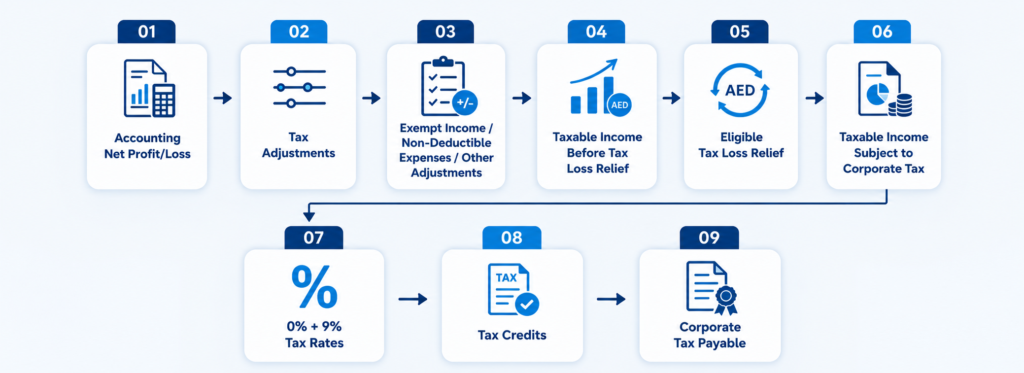
This sequence reflects the FTA’s own determination-of-taxable-income framework, and it’s worth keeping visible whenever you’re reviewing a Corporate Tax calculation, since skipping a step is one of the most common sources of errors.
Which Business Expenses Can Reduce Taxable Income?
Legitimate business expenditure incurred to derive taxable income is generally deductible, although specific rules, limitations, and timing requirements apply depending on the type of expense.
| Expense category | General treatment |
| Legitimate business expense | Generally deductible |
| Personal expenditure | Generally not deductible |
| Capital expenditure | Generally recognised through depreciation/amortisation rather than an immediate deduction |
| Expense related to exempt income | May be restricted |
| Entertainment expenditure | Subject to specific rules |
| Disallowed interest | Subject to limitation rules |
Because deductibility depends on the nature and purpose of each expense, this table is a general guide rather than a blanket rule; specific expenses are best checked against the Corporate Tax Law directly.
What Income Is Exempt From UAE Corporate Tax?
Certain categories of income and entities can benefit from Corporate Tax exemptions, though not every exemption applies universally, and eligibility depends on meeting specific conditions:
- Certain government entities
- Certain government-controlled entities
- Extractive businesses, subject to conditions
- Non-extractive natural resource businesses, subject to conditions
- Qualifying public benefit entities
- Qualifying investment funds
- Certain pension and social security funds
- Certain qualifying subsidiaries
- Participation exemption
Participation exemption fact
Under the Corporate Tax Law, qualifying income from a Participating Interest can be exempt, subject to conditions. The legislation defines a Participating Interest using a 5% ownership threshold, along with other requirements, including a minimum holding period.
How Does Corporate Tax Work for Free Zone Companies in UAE?
| Business status | Potential Corporate Tax treatment |
| Mainland Taxable Person | 0% up to AED 375,000; 9% above threshold |
| Free Zone Person | Subject to Corporate Tax rules |
| Qualifying Free Zone Person | 0% on Qualifying Income, subject to conditions |
| QFZP non-qualifying income | May be subject to 9% |
The Ministry of Finance confirms that Qualifying Free Zone Persons can benefit from a 0% rate on Qualifying Income, provided they meet conditions around substance, income type, and audited financial statements.
Is Corporate Tax Different in Dubai and Abu Dhabi?
No. There is no separate standard Dubai Corporate Tax rate that applies simply because a company operates in Dubai, and the same federal Corporate Tax framework applies across the entire UAE. Searches such as “Dubai company taxes” and “tax in Abu Dhabi” shouldn’t lead readers to assume there are separate federal Corporate Tax rates by emirate, because there aren’t.
| Location | Federal Corporate Tax framework |
| Dubai | 0% up to AED 375,000 taxable income; 9% above that threshold |
| Abu Dhabi | 0% up to AED 375,000 taxable income; 9% above that threshold |
| Sharjah | 0% up to AED 375,000 taxable income; 9% above that threshold |
| Ajman | 0% up to AED 375,000 taxable income; 9% above that threshold |
| Umm Al Quwain | 0% up to AED 375,000 taxable income; 9% above that threshold |
| Ras Al Khaimah | 0% up to AED 375,000 taxable income; 9% above that threshold |
| Fujairah | 0% up to AED 375,000 taxable income; 9% above that threshold |
Certain emirate-level taxes or sector-specific charges may exist in particular circumstances, municipality fees or tourism levies, for example, but these shouldn’t be confused with the federal Corporate Tax regime. The FTA also confirms that emirate-level taxes don’t reduce the amount of federal Corporate Tax payable; the two sit alongside each other rather than offsetting.
What Are the UAE Corporate Tax Filing Deadlines?
The general rule is straightforward: a Corporate Tax return is due within 9 months of the end of the relevant Tax Period. Applied to specific Tax Period end dates, that looks like this:
| Tax Period end | General filing/payment deadline |
| 31 December 2025 | 30 September 2026 |
| 31 March 2026 | 31 December 2026 |
| 30 June 2026 | 31 March 2027 |
| 30 September 2026 | 30 June 2027 |
This table illustrates the general nine-month rule; businesses should confirm their own specific Tax Period and check current FTA requirements before relying on any single date, since a business’s Tax Period follows its financial year rather than the calendar year by default.
It’s worth keeping this separate from the Corporate Tax registration deadline, which is a different, earlier requirement. Registration deadlines were set out under FTA Decision No. 3 of 2024 based on a business’s trade licence issue month, with a fixed AED 10,000 penalty for missing them, and that timeline has already passed for most existing businesses. The filing deadline covered here applies to each Tax Period’s return, on an ongoing basis, for as long as the business operates. For the full registration timeline, see our guide on how to register for Corporate Tax in the UAE.
If you’ve already missed a registration or filing deadline, that AED 10,000 penalty isn’t necessarily final. Our article on Corporate Tax penalty waivers covers when the FTA’s relief scheme can apply and how to request a waiver.
What Is the Corporate Tax Certificate in UAE?
A few related terms get used interchangeably, but they refer to different things:
- Corporate Tax registration is the process of enrolling a business with the FTA for Corporate Tax purposes.
- Corporate Tax Registration Number (TRN) is the unique identifier issued once registration is approved.
- Corporate Tax return is the periodic filing a business submits, reporting its taxable income and tax payable for a given Tax Period.
- A Corporate Tax certificate refers to the relevant tax documentation issued by the FTA, such as the Corporate Tax Registration Certificate confirming that a business is registered; it is not the same as the TRN itself, even though the two are closely linked.
If you haven’t registered yet, our Corporate Tax registration service walks you through the process end-to-end.
What Records Should Businesses Keep for Corporate Tax?
The FTA states that relevant records and documents must generally be retained for at least seven years following the end of the relevant Tax Period. A practical compliance checklist includes:
- Financial statements
- General ledger
- Invoices
- Expense records
- Bank statements
- Payroll records
- Fixed asset records
- Tax calculations
- Tax-return supporting documents
- Related-party transaction records
- Transfer pricing documentation, where applicable
- Evidence supporting deductions and exemptions
What About the 15% UAE Corporate Tax Rate?
15% is not the standard UAE Corporate Tax rate for ordinary businesses. It relates to a separate measure: the UAE Domestic Minimum Top-up Tax (DMTT), which applies only to in-scope multinational enterprise groups meeting a global revenue threshold of €750 million or more in at least two of the four preceding financial years. The UAE DMTT applies for financial years beginning on or after 1 January 2025.
| Rule | Rate/Threshold | Who it concerns |
| Standard UAE Corporate Tax | 0% / 9% | General taxable businesses |
| 0% threshold | AED 375,000 | Taxable Income |
| UAE DMTT | Minimum effective tax framework | In-scope large MNE groups |
| MNE revenue threshold | €750 million | Consolidated global revenue test |
For the overwhelming majority of UAE SMEs, the DMTT simply doesn’t apply. If you’re a smaller business researching a 15% figure, it’s almost certainly this measure you’ve come across, not a rate that applies to your own Corporate Tax bill.
How Map My Books Helps Corporate Tax Services
As one of the top accounting firms in the UAE, Map My Books helps corporate tax services by providing:
- Corporate Tax Registration Support: We help businesses understand their registration obligations and prepare the required information correctly the first time, avoiding the common errors that delay approval.
- Corporate Tax Calculation Support: From accounting income through to final Corporate Tax payable, we work through each adjustment, loss relief calculation, and credit so your taxable income figure is accurate and defensible.
- Corporate Tax Filing Support: Our Corporate Tax Filing service prepares and reviews your Corporate Tax information before filing, checking it against your underlying records to ensure nothing is missed ahead of the deadline. O
- Corporate Tax Consultancy: For businesses navigating exemptions, reliefs, or structural questions, our Corporate Tax Consultancy service provides tailored guidance rather than generic answers.
- Transfer Pricing Support: For companies with related-party transactions, arm’s length pricing and proper documentation aren’t optional extras; they’re a core part of staying compliant. Our Transfer Pricing Consultant service covers both.
- Support for Dubai and Businesses Across the UAE: We work with businesses in Dubai, Abu Dhabi, Sharjah, Ajman, Ras Al Khaimah, Fujairah, and Umm Al Quwain, applying the same federal Corporate Tax framework consistently across emirates.
Need help calculating or filing Corporate Tax in the UAE? Contact Map My Books for professional Corporate Tax support.
How Can a Corporate Tax Calculator Help UAE Businesses?
A Corporate Tax calculator won’t replace a proper review of your accounts, but it’s a genuinely useful first step. It gives a business a rough sense of its likely liability before committing time to a full calculation, helps flag early whether taxable income is likely to sit above or below the AED 375,000 threshold, and makes it easier to compare scenarios, for example, the impact of claiming a deduction or applying tax loss relief, without redoing the maths by hand each time.
Used well, a calculator is a starting point for a conversation with your accountant, not a substitute for one, since it can’t account for the specific adjustments, exemptions, or reliefs that apply to your business.
Frequently Asked Questions About UAE Corporate Tax Calculation
How Much Is Corporate Tax On AED 500,000 Profit?
AED 500,000 − AED 375,000 = AED 125,000
AED 125,000 × 9% = AED 11,250
This assumes AED 500,000 is the final Taxable Income figure, with no other adjustments, reliefs, or credits applied.
How Much Corporate Tax Is Payable On AED 1 Million Taxable Income?
AED 1,000,000 − AED 375,000 = AED 625,000. AED 625,000 × 9% = AED 56,250.
What Is Small Business Relief In The UAE?
Small Business Relief allows an eligible resident taxable person with revenue not exceeding AED 3 million to be treated as having no taxable income for the period, thereby removing their Corporate Tax liability entirely. Following Ministerial Decision No. 131 of 2026, the relief now applies to tax periods ending on or before 31 December 2029. See our full breakdown of how UAE Corporate Tax affects SMEs for eligibility, exclusions, and what to prepare for.
Does UAE Corporate Tax Apply To Revenue or Profit?
Taxable income, not revenue. Corporate Tax is calculated on accounting profit after tax adjustments and eligible loss relief, so a high-revenue, low-margin business can owe far less than its turnover might suggest.
Are All Dividends Exempt From UAE Corporate Tax?
No. Qualifying dividends and participation income may be exempt subject to specific conditions, including ownership thresholds and holding periods, but exemption isn’t automatic for every dividend a business receives.
Do Companies Need A Commercial Tax Officer In UAE?
There’s no formal UAE requirement to appoint a dedicated “commercial tax officer.” Businesses generally rely on internal finance staff, an accountant, or an external Corporate Tax adviser to manage registration, calculation, and filing.
Who Will Pay Corporate Tax In The UAE?
Resident juridical persons, natural persons whose turnover exceeds AED 1 million, and non-residents with a UAE permanent establishment or UAE-sourced income through a UAE nexus. Whether tax is actually payable then depends on taxable income, exemptions, and any relief claimed.
How Does Business Accounting Software Help With Corporate Tax?
Accounting software keeps income and expenses recorded accurately throughout the year rather than reconstructed at year-end, which makes tax adjustments easier to identify, supports audit readiness, and reduces the risk of errors carrying through into the Corporate Tax return.