Understanding value-added tax compliance in the United Arab Emirates requires a clear grasp of how different tax mechanisms operate across various transaction types. While the standard VAT framework places the responsibility of calculating, collecting, and remitting tax on the supplier, certain domestic and cross-border transactions require an alternative approach to maintain compliance and simplify tax administration.
The Reverse Charge Mechanism (RCM) shifts the obligation to account for VAT from the seller to the buyer or recipient. Primarily utilized for imported goods and services, as well as specific high-value domestic sectors like electronics, precious metals, and energy supplies, RCM ensures seamless tax collection without requiring non-resident vendors to register locally.
This comprehensive guide covers everything you need to know about UAE VAT reverse charge rules, including how RCM works, key updates from 2023 to 2026, calculation steps, reporting requirements on the VAT 201 return, and actionable compliance best practices for your business.
Key Takeaways
- RCM shifts VAT accounting from the supplier to the buyer/recipient.
- It applies only to specified supplies and statutory circumstances, not automatically to every import or B2B deal.
- The current standard UAE VAT rate is 5%.
- Fully taxable businesses can generally offset eligible input VAT against RCM output VAT, for no net cash impact.
- Box 3 is used for reverse-charge output VAT; eligible input VAT is reported in Box 10.
- Imports may also require reconciliation with Boxes 6 and 7.
- Electronics RCM has applied since 30 October 2023.
- Precious metals and stones RCM expanded from 26 February 2025.
- Self-invoicing for RCM was removed from 1 January 2026.
- RCM records should generally be retained for at least 5 years.
Need professional support for your business in the UAE?
What Is the Reverse Charge Mechanism in UAE VAT?
The Reverse Charge Mechanism (RCM) in UAE VAT is a rule under which the buyer, not the supplier, accounts for VAT on specified supplies, calculating, declaring, and (where eligible) recovering the VAT directly in their own VAT return. It applies mainly to imports and specific domestic B2B categories such as electronics, precious metals, and hydrocarbons, and it exists because the standard VAT tax rules assume the supplier charges VAT, which isn’t practical when the supplier has no UAE VAT presence. Map My Books, being a VAT service provider in Dubai, guides businesses and individuals on understanding their company’s RCM process.
Why Was the Reverse Charge Mechanism Introduced in the UAE?
RCM exists to close a structural gap in how UAE VAT is normally collected.
- Ensures VAT is collected even where the supplier isn’t required to account for UAE VAT.
- Reduces the registration burden on certain non-resident suppliers, who would otherwise need to register for UAE VAT just to sell into the country.
- Prevents tax leakage and evasion by keeping accountability with a UAE-based, already-registered party.
- Simplifies cross-border transactions, since the foreign supplier doesn’t need to navigate UAE VAT compliance through E-invoicing Mandate.
- Places VAT accounting responsibility with the UAE recipient, who is easier for the Federal Tax Authority (FTA) to identify and audit.
How Does Reverse Charge Mechanism UAE VAT Work?
At a mechanical level, RCM follows a consistent seven-step pattern regardless of the supply category:
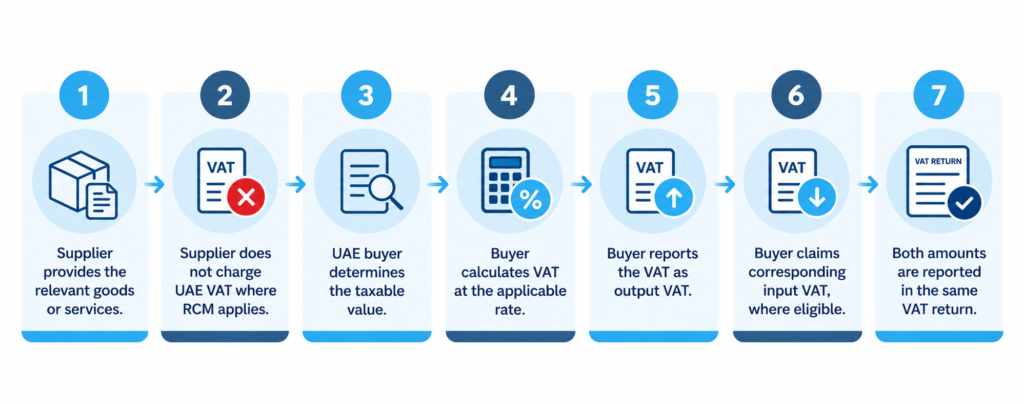
- Supplier provides the relevant goods or services.
- Supplier does not charge UAE VAT where RCM applies.
- UAE buyer determines the taxable value.
- Buyer calculates VAT at the applicable rate.
- Buyer reports the VAT as output VAT.
- Buyer claims corresponding input VAT, where eligible.
- Both amounts are reported in the same VAT return.
As an accounting consulting firm in Dubai, Map My Books provides consulting regarding the proper understanding of RCM in the UAE.
When Does the Reverse Charge Mechanism UAE VAT Apply?
RCM isn’t a blanket rule; it applies only where a transaction falls into one of several specific categories set out in the VAT Law and Executive Regulations.
Imports of Goods and Services
- Applies to imports of taxable goods or services from both GCC and non-GCC countries.
- Covers imported services from non-UAE suppliers, provided the purchase is for business purposes.
- The foreign supplier may or may not have a UAE presence, depending on the specific transaction and applicable rules.
Goods Moving From a Designated Zone to Mainland UAE
Certain movements of goods from an FTA Designated Zone into mainland UAE are treated as imports for VAT purposes, triggering reverse-charge accounting by the recipient.
Supplies From Non-Resident Suppliers
Where a non-resident supplier (one without a place of residence in the UAE) provides goods or services to a UAE taxable person, and the place-of-supply and RCM conditions are met, the UAE recipient accounts for the VAT instead of the supplier.
Oil, Gas, Hydrocarbons and Energy Supplies
- Hydrocarbons supplied for resale.
- Crude or refined oil supplied to a registered recipient.
- Processed or unprocessed natural gas.
- Production and distribution of energy.
This category is especially relevant for the UAE’s oil and gas sector, where registered suppliers and buyers transact in hydrocarbons and energy products under domestic reverse charge.
What Supplies Are Subject to Reverse Charge VAT in the UAE?
Beyond imports, several specific domestic B2B categories are also captured under UAE VAT reverse charge rules.
Electronic Devices Supplied B2B for Resale or Manufacturing
- RCM for specified electronic devices has applied since 30 October 2023.
- Relevant products include mobile phones, computers, tablets, and parts.
- Applies only where buyer declarations and the applicable statutory conditions are satisfied.
Precious Metals and Precious Stones
- Governed by Cabinet Decision No. 127 of 2024.
- Effective from 26 February 2025.
- Expanded scope beyond the earlier gold/diamond-only treatment.
- Categories now include gold, silver, platinum, palladium, and certain precious stones, subject to statutory conditions.
This is a key update for businesses in the gold and precious metals trade, since the scope of RCM widened materially in 2025.
Supplies That Are Not Automatically Covered by RCM
Being an import or a B2B transaction does not automatically mean RCM applies. Each supply category has its own conditions under the VAT Law and Executive Regulations, and those conditions must be met before reverse charge treatment is triggered.
How to Calculate Reverse Charge VAT in the UAE
The calculation itself is simple, using the current 5% standard VAT rate:
Reverse Charge VAT = Taxable Value × 5%
Worked Example: AED 100,000 Imported Services
A Dubai VAT-registered business purchases AED 100,000 of consulting services from a non-UAE supplier.
| Step | Detail |
| Foreign supplier charges UAE VAT? | No |
| UAE buyer calculates VAT | 5% × AED 100,000 = AED 5,000 |
| Declared as output VAT | AED 5,000 |
| Claimed as input VAT (if fully recoverable) | AED 5,000 |
| Net cash impact | AED 0 |
The transaction is reported through the relevant VAT 201 boxes (see below).
Reverse Charge VAT Calculation Example: AED 8,000
| Detail | Value |
| Taxable value | AED 8,000 |
| VAT rate | 5% |
| Reverse charge VAT | AED 400 |
The buyer records the AED 400 as output VAT and, if fully eligible, as recoverable input VAT in the same VAT return, again with no net cash impact for a fully taxable buyer.
How to Report Reverse Charge VAT in the UAE VAT 201 Return
RCM transactions have to be declared correctly across specific boxes on the VAT 201 return.
- Box 3, Output VAT: enter the net value of supplies subject to reverse charge. The applicable VAT becomes output tax due.
- Box 10, Recoverable input VAT: if the purchase is fully recoverable, report the eligible VAT here to offset the output VAT declared in Box 3.
- Boxes 6 and 7, Imported goods: cross-check customs information against accounting records to ensure the correct VAT is declared.
What Happens if the Business Is Partially Exempt?
- Only the recoverable portion of input VAT should be claimed.
- Do not automatically claim the entire reverse-charge VAT as input tax; the unrecoverable amount remains payable.
Input Tax Deduction Under Reverse Charge Mechanism UAE VAT
RCM works on simultaneous accounting: output VAT is recognised on the reverse-charged purchase, and eligible input VAT is claimed in the same return. For fully recoverable transactions, there is generally no net VAT cash impact.
Conditions for Claiming Input VAT
- Goods or services are used for taxable business purposes.
- The business holds valid supporting documents, such as supplier invoices or import documents.
- VAT is correctly calculated and reported.
- The expense is not blocked or restricted under UAE VAT law.
- For partially exempt businesses, only the eligible recovery portion is claimed.
Reverse Charge VAT vs Forward Charge Mechanism
| Factor | Forward Charge | Reverse Charge |
| Who charges VAT? | Supplier | Buyer/recipient accounts for VAT |
| Who reports VAT? | Supplier | Buyer/recipient |
| Supplier invoice | VAT charged where applicable | UAE VAT generally not charged where RCM applies |
| Output VAT | Supplier’s responsibility | Buyer’s responsibility |
| Input VAT | Buyer’s eligible claim | Buyer’s eligible claim |
| Common use | Normal taxable supplies | Specified RCM transactions |
What Are the Responsibilities Under RCM in UAE VAT?
Correctly applying reverse charge mechanism UAE VAT rules comes down to four practical responsibilities.
Verify VAT Registration and Transaction Eligibility
Confirm the recipient’s VAT registration status, determine whether the transaction falls within an RCM category, and check the applicable statutory conditions.
Calculate and Account for VAT Correctly
Determine the taxable value, apply the correct VAT rate, record output VAT, and claim eligible input VAT.
Maintain Supporting Documentation
Supplier invoices or alternative evidence, customs documents, buyer declarations where required, and VAT return records.
Use Correct Accounting and VAT Codes
ERP or accounting systems that identify RCM transactions and separately track output and input VAT reduce manual errors and support smoother audits.
Talk to our VAT Consultancy team
Invoices and Record-Keeping Requirements for Reverse Charge VAT
What Should a Reverse Charge Invoice Include?
Domestic reverse-charge invoices should clearly state:
“VAT to be accounted for by the recipient under the reverse charge mechanism.”
The invoice should also include the buyer’s TRN, where applicable.
What Documents Should You Keep Ready for an FTA Review?
Here are the documents needed for an FTA Review:
- Supplier invoices or alternative supporting documentation.
- Customs import declarations and shipping paperwork.
- Buyer declarations for electronic devices, precious metals, and stones.
- VAT return extracts showing reverse-charge entries, including Boxes 3 and 10.
- Accounting reports reconciling reverse-charge output and input VAT.
How Long Should RCM Records Be Kept?
Records should generally be retained for at least 5 years, with longer retention applying to certain sectors such as real estate.
2023–2026 New VAT Rules and Updates Affecting RCM in the UAE
| Update | Effective Date | What Changed |
| Electronics reverse charge | 30 October 2023 | Applies to specified electronic devices, phones, computers, tablets, and parts. Buyer declarations and correct ERP tax codes are essential. |
| Precious metals and stones | 26 February 2025 | Cabinet Decision No. 127 of 2024 expanded reverse-charge scope beyond gold/diamonds to include silver, platinum, palladium, and certain precious stones. |
| Self-invoicing removed | 1 January 2026 | Self-invoicing is no longer required for reverse-charge transactions. Businesses should retain supplier invoices or other supporting documentation substantiating the transaction and VAT treatment. |
Because RCM rules can change by transaction category, businesses should always verify current requirements against the latest UAE VAT Law, Executive Regulations, and FTA guidance rather than relying on older summaries.
What Happens If a Business Fails to Apply Reverse Charge VAT Correctly?
Missing RCM entirely, or putting reverse-charge transactions in the wrong VAT 201 boxes, creates real compliance exposure:
- Administrative penalties
- Underpayment of VAT
- Potential loss or denial of input tax recovery
- Interest and late-payment exposure, where applicable
- Increased likelihood of FTA scrutiny or audit
- Incorrect VAT 201 reporting, which compounds the above risks over multiple filing periods
Advantages and Challenges of RCM
| Advantages | Challenges |
| Cash-flow neutrality for fully taxable buyers | Identifying qualifying transactions |
| Lower VAT-registration burden for many non-resident suppliers | Correctly determining taxable value |
| Facilitates cross-border trade | Maintaining buyer declarations |
| Helps ensure VAT is collected by the UAE tax system | Correct VAT 201 reporting |
| Reduces potential tax leakage | Managing partial exemption |
| Keeping ERP/accounting tax codes accurate |
Reverse Charge VAT Compliance Checklist for UAE Businesses
Understand the Reverse Charge VAT with the compliance checklist below:
- Confirm the transaction qualifies for RCM.
- Verify VAT registration status.
- Determine taxable value.
- Apply the correct VAT rate.
- Record output VAT.
- Claim eligible input VAT.
- Report output VAT in Box 3.
- Report recoverable RCM input VAT in Box 10.
- Reconcile imported goods with Boxes 6 and 7, where relevant.
- Collect buyer declarations, where required.
- Retain supplier/customs/supporting documents.
- Ensure invoices contain reverse-charge wording, where applicable.
- Include buyer TRN, where required.
- Keep records for at least 5 years.
- Ensure ERP/accounting software flags RCM transactions.
Let Map My Books Handle It For You
Getting the reverse charge mechanism UAE VAT right, across imports, electronics, precious metals, and energy supplies, means tracking multiple rate categories, evolving effective dates, and specific VAT 201 boxes at the same time. Map My Books reviews your RCM transactions, checks your buyer declarations and documentation, maps the correct ERP tax codes, and makes sure your VAT return reflects every reverse-charge entry accurately, so nothing slips through and your business stays audit-ready.
Talk to Our VAT Consultancy Team
Frequently Asked Questions
Who Pays VAT Under The Reverse Charge Mechanism?
The buyer or recipient of the goods or services accounts for and pays the VAT, not the supplier. The buyer self-assesses the VAT and reports it directly in their own VAT return.
Is Reverse Charge VAT Cash Neutral?
For a fully taxable business, generally yes, the same VAT amount is declared as output VAT and claimed as input VAT in the same return, resulting in no net cash impact. Partially exempt businesses can only recover the eligible portion, so full cash neutrality doesn’t apply.
Do I need To Reverse Charge SaaS or Services Purchased From Abroad?
Yes, where the UAE business is VAT-registered and the place of supply is the UAE, imported services including SaaS subscriptions from a non-UAE supplier are generally subject to reverse charge.
How Should Electronics Reverse Charge Buyer Intent Be Documented?
The buyer should provide a declaration confirming their VAT registration status and confirming that the electronic devices are intended for resale or manufacturing, and this declaration should be retained alongside the invoice.
Does RCM Apply When Goods Move From A Designated Zone To Mainland UAE?
Yes. The movement is treated as an import, so the recipient accounts for VAT under reverse charge and claims recoverable input VAT where eligible.
How Does RCM Work For A Partially Exempt Business?
A partially exempt business applies its recovery ratio and claims only the recoverable portion of the reverse-charged VAT in Box 10, the unrecoverable portion remains a real cost.
Is Self-Invoicing Required For Reverse Charge Transactions In 2026?
No. Self-invoicing was removed from 1 January 2026. Businesses should instead retain supplier invoices or other supporting documentation substantiating the transaction and VAT treatment applied.
How Should A Domestic Reverse Charge Invoice Be Worded?
It should state that VAT is to be accounted for by the recipient under the reverse charge mechanism, and include the buyer’s TRN where applicable.
How Many Types Of VAT Are There In The UAE?
UAE VAT applies at three main treatments: the standard rate of 5%, zero-rated supplies (taxed at 0%, with input VAT still recoverable), and exempt supplies (no VAT charged, and input VAT generally not recoverable). Reverse charge sits alongside these as a mechanism for accounting for VAT, not a separate rate.
What Is The Difference Between Regular Invoicing And Invoicing Under RCM?
Under regular (forward charge) invoicing, the supplier charges VAT on the invoice and remits it to the FTA. Under RCM, the supplier issues the invoice without charging UAE VAT, and the buyer separately calculates, declares, and (where eligible) recovers the VAT in their own VAT return.
This guide reflects UAE VAT rules as summarised here for general informational purposes. VAT treatment depends on the specific facts of each transaction, always verify current requirements against the latest UAE VAT Law, Executive Regulations, and FTA guidance, or speak with our team, before relying on this for a specific transaction.