Opening a real estate company in Dubai isn’t a single, fixed process; it depends on the specific real estate activity you choose, your legal structure, your jurisdiction, and the regulatory approvals attached to that activity. The Dubai Land Department (DLD) regulates a wide range of real estate activities, including brokerage, consultancy, development, property management, valuation, and mortgage brokerage, each with its own licensing and compliance requirements. This guide covers business models, mainland vs. free zone, licensing, RERA requirements, costs, documents, banking, and ongoing compliance, so you can plan your setup accurately instead of relying on a generic checklist.
Key Takeaways:
- Dubai’s real estate sector recorded 226,000 transactions worth AED 761 billion in 2024, real evidence of a market with genuine scale.
- The specific real estate activity you choose determines your licence, approvals, and whether you or your staff need a RERA professional practice card.
- Costs vary widely by activity: DLD’s annual activity fee alone ranges from AED 5,000 to AED 25,000, before you add company licensing, office, and visa costs.
- Mainland brokerage requires a physical, Ejari-registered office; virtual offices and flexi-desks generally aren’t accepted for brokerage activities.
- A RERA broker card and exam are required before an individual can practise regulated brokerage activity, separate from the company’s own trade licence.
As one of the best chartered accounting firms in the UAE, Map My Books provides guidance on forming a real estate company in Dubai.
Why Start a Real Estate Business in Dubai?
Dubai’s real estate market is well documented, not just marketing language. According to the Dubai Land Department’s own reporting, Dubai recorded 226,000 real estate transactions worth AED 761 billion in 2024, a 36% increase in volume and a 20% increase in value year-on-year. Separately, the market recorded 217,000 investments valued at AED 526 billion, and Dubai attracted 110,000 new real estate investors in 2024, a 55% increase from the previous year. Momentum has continued since then: DLD reported over AED 917 billion in transactions in 2025.
This activity creates opportunity across several distinct parts of the market: residential sales, commercial property, leasing, property management, consultancy, and development. A new entrant doesn’t need to compete across all of them; the range of DLD-regulated activities means a business can specialise in exactly the segment that fits its expertise and capital.
What Types of Real Estate Businesses Can You Start in Dubai?
DLD currently lists a defined set of regulated real estate activities, including consultancy, development, sales and purchase brokerage, leasing brokerage, valuation, property inspection, private and third-party property management, mortgage brokerage, and other specialised activities. Here’s what each business model typically involves:
Real Estate Brokerage
Buying, selling, and leasing brokerage, acting as the intermediary between buyers, sellers, landlords, and tenants, and earning commission on completed transactions. This is the most common entry point for new real estate businesses in Dubai.
Property Management Company
Managing properties either privately (for a single owner or portfolio) or as a third-party manager acting on behalf of multiple owners, covering tenant relations, maintenance coordination, and rent collection.
Real Estate Consultancy
Providing property information, market data, and pricing consultancy to investors, developers, or buyers, without necessarily handling transactions directly.
Real Estate Development
Developing and marketing real estate projects, from land acquisition through construction and sales, generally the most capital-intensive and heavily regulated of these activities.
Real Estate Marketing Agency
Property promotion and project marketing, working alongside developers and brokerages to generate demand and manage campaigns for specific projects.
Real Estate Valuation Business
Providing formal property valuations, a specialised, licensed activity requiring its own DLD-recognised qualification.
Mortgage Brokerage or Consultancy
Advising buyers on financing options and facilitating mortgage arrangements between buyers and lenders.
Real Estate Service or Trustee Activities
Other specialised DLD-regulated services, including property inspection and trustee-related activities connected to property transactions.
How to Open a Real Estate Company in Dubai Step by Step?
Step 1: Decide Which Real Estate Activity You Will Offer
Define whether the company will focus on brokerage, property management, consultancy, development, valuation, mortgage services, or another approved activity; this decision shapes every step that follows.
Step 2: Choose the Legal Structure
Select the appropriate company structure based on ownership, business activity, and jurisdiction (LLC, sole establishment, or a free-zone structure).
Step 3: Choose Mainland or Free Zone
Assess your operating model and the applicable DLD/RERA requirements before selecting the jurisdiction; this choice has real consequences for real estate specifically (see the comparison below).
Step 4: Reserve Your Trade Name
Select and reserve an acceptable business name with the relevant licensing authority (DET for mainland, or the applicable free-zone authority).
Step 5: Obtain Initial Approval
Complete the initial approval process with your licensing authority before proceeding with the remaining incorporation requirements.
Step 6: Apply for the Real Estate Licence
Submit the company licensing application for your selected real estate activity.
Step 7: Complete DLD/RERA and Trakheesi Requirements
Register with the relevant DLD systems and obtain the approvals or professional practice cards applicable to your activity. DLD states that you can submit real estate licensing applications through Trakheesi or Invest in Dubai, depending on the case.
Step 8: Arrange the Required Office
Complete the applicable office and tenancy requirements, including Ejari registration where required.
Step 9: Obtain Broker or Professional Practice Cards
Complete the relevant qualification, examination, and registration process for any employees or partners who will practise regulated activities.
Step 10: Open a Corporate Bank Account
Prepare your company licence, registration documents, and the KYC documents your bank will require.
Step 11: Complete Visa and Employee Requirements
Process investor and employee visas according to your company’s approved quota and structure.
Step 12: Launch and Maintain Compliance
Set up operations, marketing, and property listings while maintaining ongoing DLD/RERA, licensing, tax, and corporate compliance.
What Documents Are Needed to Open a Real Estate Company in Dubai?
- Passport copies of owners/shareholders
- Emirates ID and residency documents, where applicable
- Proposed trade names
- Initial approval documentation
- Corporate formation documents
- Office tenancy documentation
- Relevant NOCs, for applicable free-zone structures
- Industry-specific approvals
- Professional qualification documents for relevant individuals
- Good conduct certificate, where required
- Additional documents depending on the selected real estate activity
For regulated activities specifically, DLD may request further activity-specific documentation and approvals beyond the general list above; brokerage, valuation, and development each carry their own additional requirements.
How Much Does It Cost to Start a Real Estate Company in Dubai?
There’s no single fixed setup price. Total cost depends on your real estate activity, mainland vs. free zone, number of shareholders, office requirements, visa requirements, professional practice cards, DLD/RERA approvals, employees, technology and CRM, marketing, and any professional setup services you use.
Typical Cost Components
| Cost | Reference Figure / Consideration |
| Trade name reservation | AED 620 to AED 2,000 |
| Initial approval | Roughly AED 120 to AED 870, depending on structure |
| RERA/professional requirements | Varies by activity and individual requirement |
| Real estate broker card | AED 500 (AED 520 including knowledge and innovation fees) |
| Broker exam | AED 700 + AED 10 knowledge fee + AED 10 innovation fee (plus a further AED 50 ERES fee + VAT) |
| Real estate activity licensing | Varies by activity: DLD currently lists AED 5,000 annual fee for standard activities (brokerage, consultancy), AED 10,000 for exhibition/valuation-type activities, with higher tiers for property management and development, plus applicable knowledge and innovation fees |
| Office | Depends heavily on location, size, and fit-out |
| Employees | Salaries, visas, and employment costs |
| Banking | Bank-specific minimum balance and account requirements |
| Marketing | Website, portals, branding, advertising, and lead generation |
| Technology | CRM, property management, and communication tools |
As a general benchmark, a mainland brokerage with a real Ejari-registered office, one or two RERA-carded brokers, and a standard trade licence typically lands somewhere in the AED 30,000–100,000+ range for the first year, before ongoing marketing, staffing, and technology costs. Treat this as a planning benchmark, not a quote; your actual cost depends entirely on the specific components above.
What Are the DLD and RERA Fees for Different Real Estate Activities?
Using DLD’s current published fee schedule:
- Real estate development: AED 25,000 annual fee
- Real estate leasing and management services for others: AED 15,000 annual fee
- Real estate exhibition organisation/valuation: AED 10,000 annual fee
- Other listed activities (including standard sales, leasing, and mortgage brokerage): AED 5,000 annual fee
- Knowledge and Innovation fee: AED 20 (AED 10 knowledge + AED 10 innovation), applied on top of most DLD service fees, including activity licensing and professional card issuance
It’s worth being clear that company formation, licensing, office, visa, and professional costs are all separate from these activity-specific DLD fees. The DLD activity fee is just one line item in your total setup cost, not the total cost itself, a mistake many first-time founders make when budgeting.
What Are the Real Estate Business Activities in the UAE?
Select your activity before applying for a company licence, because the permitted activity determines every regulatory requirement that follows, not the other way around. DLD’s current activity list includes:
- Brokerage for property sales and purchases
- Leasing brokerage
- Property management
- Real estate consultancy
- Real estate development
- Property valuation
- Mortgage consultancy and brokerage
- Buying and selling land and properties
- Property inspection
- Real estate project marketing
- Real estate representation
It’s worth distinguishing between two separate layers of licensing here: company-level licensing (your trade licence, covering what your business as a whole is authorised to do) and individual professional practice requirements (the broker card, valuation card, or other professional card an individual employee needs before practising a regulated activity personally). A company can hold a valid brokerage licence while an individual employee still can’t legally practise brokerage without their own card.
How to Choose Between Mainland, Offshore and Free Zone for a Dubai Real Estate Company?
Mainland Real Estate Company
A mainland licence through Dubai’s Department of Economy and Tourism (DET) gives the most straightforward path to full DLD/RERA registration and is generally the standard route for businesses directly serving the Dubai property market. Real estate activity approvals run through DET alongside the applicable DLD/Trakheesi systems, and for brokerage specifically, a mainland structure is where most established firms operate, given the mandatory physical-office requirement. Real estate companies seeking company formation in the Mainland can consult with Map My Books for a proper company formation setup.
Free Zone Real Estate Company
A free-zone licence can offer benefits like streamlined setup and, for certain structures, full foreign ownership without a local partner. However, for a free-zone company to practise a DLD-regulated real estate activity in Dubai, it generally needs a No Objection Certificate (NOC) from the relevant free-zone licensing authority, in addition to the same DLD/RERA requirements a mainland company would face. A free-zone licence doesn’t bypass DLD/RERA regulation; it adds a coordination step before that regulation applies.
Offshore Real Estate Company
An offshore structure is generally used to hold real estate assets or facilitate international ownership arrangements, rather than as a vehicle for actively practising DLD-regulated activities like brokerage or property management inside Dubai. Offshore companies typically can’t sponsor visas or hold a DLD trade licence to actively operate a brokerage or management business on the ground. With Map My Books’ offshore company formation setup, real estate businesses in Offshore can get advice on their company formation.
Which is right for you comes down to your business activity, target customers, operating model, and regulatory requirements, not a fixed rule that one structure is always superior. A brokerage actively serving Dubai clients from a physical office will almost always end up mainland; a holding structure for property assets may suit offshore; a free zone can work well for supporting activities that don’t require daily DLD-regulated practice.
What Are the Requirements to Open a Real Estate Company in Dubai?
- Choose the real estate activity
- Select the legal structure
- Reserve the trade name
- Obtain initial approval
- Obtain the relevant trade licence
- Complete DLD/RERA requirements applicable to the activity
- Register through Trakheesi, where required
- Obtain professional practice cards, where applicable
- Secure the required office arrangement
- Complete immigration and visa requirements
- Open a corporate bank account
- Complete tax registrations, where applicable
Requirements genuinely vary by activity; not every real estate activity carries identical approval or practice-card requirements. A pure consultancy business, for example, may face lighter professional-card requirements than a brokerage or a third-party property management business.
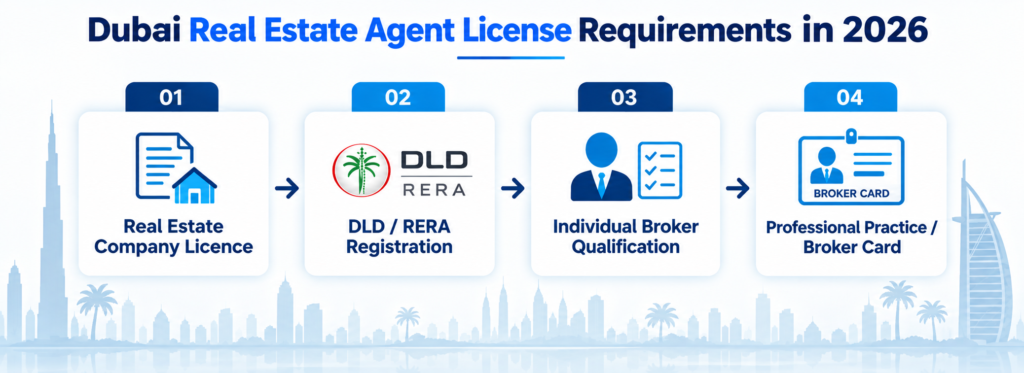
What Are the Dubai Real Estate Agent License Requirements in 2026?
For individuals specifically working as real estate brokers, the requirements are distinct from the company’s own licensing:
- A broker must hold a commercial licence covering real estate brokerage activities (held by the company they work under).
- Registration in DLD’s brokers registry is required.
- A broker must obtain the relevant RERA broker card.
- DLD identifies two broker categories: those selling properties and those leasing properties, and the applicable registration can differ between the two.
- Broker applicants must meet qualification, conduct, and residency requirements depending on their status.
- The broker card’s validity is linked to the validity of the licence it’s registered under; if the company’s licence lapses, the broker’s authority to practise under it ends too.
The chain works like this:
Real estate company licence → DLD/RERA registration → individual broker qualification → professional practice/broker card.
Do You Need RERA Certification to Start a Real Estate Business in Dubai?
It depends on the activity and the person’s specific role. RERA/DLD requirements aren’t uniform across every real estate business; individuals practising regulated activities (brokerage, valuation, mortgage consultancy) generally need the relevant professional practice card, while others in more administrative or support roles may not.
For brokers specifically, they must complete the applicable examination and professional registration requirements before they can practise. Current DLD information lists a real estate broker card fee of AED 500 and a broker exam fee of AED 700 plus an AED 10 knowledge fee and AED 10 innovation fee, subject to the stated terms and any additional charges (such as the ERES fee) that may apply.
Critically: a person cannot practise the activity registered on the licence without the designated professional card, where one is required. Holding a company licence alone doesn’t authorise an individual to personally carry out regulated activity.
Do Real Estate Companies in Dubai Need an Office and Ejari?
Office requirements depend on your company structure and activity; this isn’t a universal, one-size-fits-all rule. If a physical tenancy is required, it must comply with the relevant licensing authority’s requirements, and the contract must be registered through Ejari, the system used to formally register tenancy contracts in Dubai.
For mainland real estate brokerage specifically, a physical, Ejari-registered office is generally mandatory; virtual offices and flexi-desks are typically not accepted for brokerage activities, given the regulatory expectation of a genuine, client-facing business presence. Beyond the licensing requirement itself, a physical office matters practically for client meetings, housing staff, signage and brand presence, running CRM/technology infrastructure, and day-to-day regulatory operations.
Other real estate activities, such as consultancy or certain support services, may have more flexible office requirements, so it’s worth confirming what applies to your specific licensed activity rather than assuming brokerage-level requirements apply universally.
How Do You Register a Real Estate Company With DLD and Trakheesi?
- Trakheesi account: Your business’s registration point within DLD’s licensing system.
- Real estate activity application: Submitted for your specific chosen activity.
- Document submission: The documentation checklist covered earlier in this guide.
- Review and approval: DLD reviews the application against the requirements for your activity.
- Payment: The applicable activity fees, card fees, and any additional charges.
- Issuance of relevant documents/cards: Your activity licence and any required professional practice cards.
- Marketing permits: For applicable property advertising.
DLD states that real estate licensing applications can be processed through Trakheesi, and that some activities require a professional practice card before the activity can be practised; registration and the right to practise aren’t automatically the same.
What Are the Rules for Advertising Properties in Dubai?
Property advertising in Dubai is regulated, not a free-for-all across portals and social media. Key requirements include:
- Compliance with DLD/RERA advertising requirements
- Registration and permitting through the Trakheesi system
- Marketing permits, where applicable to the specific listing or project
- Use of approved property information only; listings need to reflect verified, accurate property details
- Broker registration, since listings are generally expected to be tied to a registered, carded broker
- Verification of licences and permits before advertising begins
- Compliance when publishing listings across property portals, websites, and social media; the same rules apply regardless of channel
DLD provides a service to verify real estate licences and permits issued through Trakheesi, giving both consumers and industry participants a way to confirm a listing or agent is properly authorised before engaging with them.
How Do You Open a Corporate Bank Account for a Dubai Real Estate Company?
Banks will typically request:
- Your trade licence
- Certificate of incorporation/registration documents
- Shareholder and director identification
- Business activity information
- Source-of-funds information
- A business plan or supporting contracts, where requested
- Your expected transaction profile
- Bank-specific KYC requirements
Minimum balance requirements vary meaningfully by bank; there’s no single universal figure (avoid treating any single number, such as AED 50,000, as a fixed requirement across all banks). Compare a few banks directly, since requirements and account features can differ significantly for a real estate business specifically, given the transaction volumes and compliance scrutiny involved.
Get help with Bank Account Opening Assistance in Dubai
What Taxes and Compliance Requirements Apply to a Dubai Real Estate Company?
- VAT registration and filing in Dubai, where your business meets the applicable threshold.
- Corporate Tax registration in Dubai, required for applicable entities regardless of activity.
- Record keeping and accounting, maintained on an ongoing basis.
- Invoicing and financial documentation, kept VAT-compliant where applicable.
- Banking and transaction records, particularly important given the value of real estate transactions.
- DLD/RERA compliance, maintained continuously, not just at setup.
- Licence renewal, both company-level and activity-level.
- Professional card renewal, for every carded individual in the business.
- Ongoing employee and immigration compliance, as staff join, leave, or change roles.
How Can You Build a Successful Real Estate Business in Dubai?
- Choose a specific property segment rather than trying to serve every buyer, tenant, and investor at once.
- Understand your target buyer, tenant, or investor well enough to tailor your service and marketing to them.
- Build a compliant property-listing process, so every listing meets DLD/RERA advertising requirements from day one.
- Invest in qualified brokers and sales staff, properly carded and genuinely capable, not just licensed on paper.
- Build relationships with developers and property owners, the deal flow that sustains a brokerage long-term.
- Use CRM and property management technology to manage leads, listings, and client relationships at scale.
- Develop organic and paid lead-generation channels, rather than relying on a single source of enquiries.
- Track enquiries, viewings, conversions, and commissions, so you actually know what’s working.
- Maintain DLD/RERA compliance as a continuous discipline, not a one-time setup task.
- Build a reputation around accurate listings and responsive service, the two things that most reliably generate referrals in this market.
What Challenges Do New Real Estate Companies Face in Dubai?
- Competition: Many licensed brokers and established agencies compete for the same buyers and listings.
- Lead generation: Consistently and cost-effectively acquiring qualified property buyers and tenants is an ongoing challenge, not a one-time setup task.
- Regulatory compliance: Multiple licensing and activity-specific requirements need to be tracked and renewed correctly.
- Market cycles: Demand can shift meaningfully across property segments and price points over time.
- Recruitment: Finding qualified, properly registered, and genuinely compliant real estate professionals can be difficult, especially when scaling quickly.
- Operating costs: Office, technology, staff, and marketing can significantly affect cash flow, particularly in the early months.
- Listing quality: Accurate property information and fully compliant advertising are essential; errors here carry real regulatory risk, not just reputational risk.
How Can Map My Books Help With Real Estate Company Formation in Dubai?
- Business activity consultation, helping you choose the right real estate activity for your goals and capital.
- Mainland and free-zone company formation assistance, matched to your specific business model.
- Trade licence assistance, through DET or the relevant free-zone authority.
- Documentation support, prepared correctly the first time.
- Visa processing assistance, for investors and employees.
- Corporate bank account opening assistance, coordinated with your specific bank’s requirements.
- Accounting setup, built around your real estate transaction volume.
- VAT registration and VAT return filing.
- Corporate Tax registration and Corporate Tax filing.
- Ongoing accounting and compliance support, well beyond the day your licence is issued.
Explore Company Formation service in the UAE
Try our UAE Company Cost Calculator and VAT Calculator for an early estimate before you commit. Also, use our UAE Business Assessment Tool to see which structure fits your real estate business model.
Frequently Asked Questions About Opening a Real Estate Company in Dubai
Can a foreigner open a real estate company in Dubai?
Yes. Foreign nationals can open real estate companies in Dubai through mainland structures (subject to the applicable ownership rules for the activity) or free-zone structures, though DLD/RERA registration requirements apply regardless of the jurisdiction chosen for activities practised in Dubai.
How long does it take to open a real estate company in Dubai?
Timelines vary by activity and structure, but a real estate brokerage setup, from trade name reservation through to a fully licensed, RERA-registered company, typically takes somewhere in the range of a few weeks to two months, depending on how quickly documentation, office arrangements, and broker qualifications are completed.
Can I start a real estate business in Dubai without becoming a broker?
Yes. You can own and operate a real estate company, including a brokerage, without personally holding a broker card, provided you employ or partner with properly RERA-carded brokers to carry out the regulated brokerage activity itself.
Do I need a RERA card to work as a real estate agent in Dubai?
Yes. Anyone personally practising a regulated real estate activity, such as brokerage, generally needs the applicable RERA professional practice card, separate from the company’s own trade licence.
Can a real estate company in Dubai operate from a free zone?
Yes, but a free-zone real estate company generally needs an NOC from its free-zone licensing authority to practise DLD-regulated activities in Dubai, and the same DLD/RERA requirements that apply to mainland companies still apply.
Can I start a property management company in Dubai?
Yes, property management (private or third-party) is a recognised, DLD-regulated activity with its own licensing and compliance requirements, distinct from brokerage.
Why Dubai Continues to Attract Real Estate Entrepreneurs?
Sustained transaction growth (226,000 transactions worth AED 761 billion in 2024 alone), 110,000 new investors entering the market that year, and a clearly regulated, transparent licensing framework through DLD and RERA continue to draw entrepreneurs who want a scalable, credible market to operate in.
Can I start a real estate company in Dubai?
Yes, provided you select an appropriate real estate activity, complete the relevant company formation and DLD/RERA registration steps, and meet the specific requirements (including any professional practice cards) tied to your chosen activity.
Do I need a physical office to start a real estate business in Dubai?
For mainland brokerage specifically, yes, a physical, Ejari-registered office is generally required. Other activities and jurisdictions may have more flexible office requirements, so this should be confirmed against your specific activity and structure.
What is the biggest challenge for new real estate businesses?
Consistent, cost-effective lead generation combined with regulatory compliance tends to be the biggest ongoing challenge; it’s not simply about getting licensed, it’s about sustainably generating qualified enquiries while staying compliant as the business grows.
Is Dubai a good place to start a real estate business?
Based on the market data alone, a growing, high-value transaction market with a record number of new investors, combined with a clear, well-established regulatory framework, Dubai remains a strong environment for a properly structured, compliant real estate business.
Disclaimer: Costs, fees, and regulatory information in this guide reflect the current DLD/RERA fee schedule and market data as researched, and are provided for general informational purposes. Fees and requirements can change; confirm current figures directly with DLD, RERA, or Map My Books before making setup decisions.